- share:
-

-

-

Increase your knowledge, be more efficient, less frustrated – and upgrade your résumé – through high‑quality telecom training courses from Teracom Training Institute coupled with telecommunications certification from the Telecommunications Certification Organization.
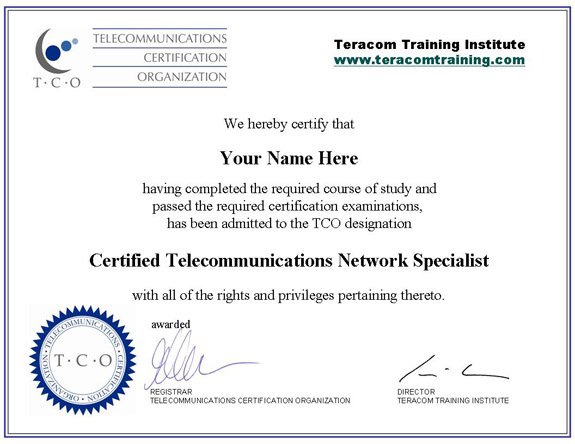
Choose from these TCO Certifications:
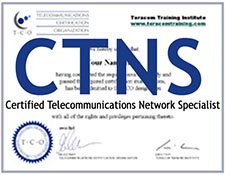
CTNS Certified Telecommunications Network Specialist
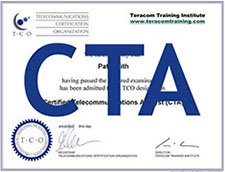
CTA Certified Telecommunications Analyst
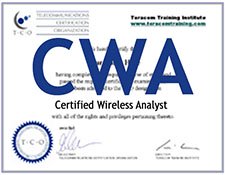
CWA Certified Wireless Analyst
CIPTS Certified IP Telecom Network Specialist
CTSME Certified Telecommunications Subject Matter Expert
printed study guides available save with bundles
CTNS Certification covers the core knowledge required by everyone serious in telecom today.
The Certified Telecommunications Network Specialist courses will teach you the fundamental concepts and technologies, plus the jargon and the buzzwords, used in broadband converged IP telecommunications. Finally, you will learn how all of it fits together.
CTNS Certification demonstrates you are up to speed on major topics including broadband converged IP telecom, WiFi and mobile wireless, SIP and VoIP, PSTN, Optical Ethernet, LANs, IP addresses, routers, MPLS VPNs, SD-WANs and the Layers ... a valuable thought to plant in your manager or recruiter's mind.
For employers, the online CTNS courses and TCO CTNS certification are a cost-efficient, consistent and effective way to ensure team members have the knowledge necessary for productivity and accuracy.
CTNS Certification is received after passing 8 individual course exams, each having 10 multiple-choice questions.
It is accompanied by a personalized Reference Letter outlining the knowledge you have and providing contact information for verification.
The coursework for CTNS contains eight high-quality online courses. It starts with 4 courses on telecommunications:
• 2241 BROADBAND CONVERGED IP TELECOM INTRODUCTION
• 2206 WIRELESS TELECOMMUNICATIONS
• 2221 FUNDAMENTALS OF VOIP
• 2201 POTS & THE PSTN
Followed by 4 courses on networking:
• 2212 THE OSI LAYERS & PROTOCOL STACKS
• 2211 LANS, VLANS, WIRELESS & OPTICAL ETHERNET
• 2213 IP NETWORKS, ROUTERS & ADDRESSES
• 2214 MPLS & CARRIER NETWORKS
The CTNS Certification Package - Unlimited Plan includes the CTNS Certification Exam and eight CTNS Courses with unlimited repeats – which means if you do the work, you are guaranteed to pass, plus you can refresh your knowledge anytime.
Completing the Certified Telecommunications Analyst Certification is the best way to show you have a very strong knowledge of telecommunications. The CTA is the most comprehensive telecom certification available. CTA demonstrates both a deep and very broad knowledge of telecom, datacom and networking.
This knowledge enables the CTA to perform analysis and make recommendations in jobs like Telecom Analyst and Subject Matter Expert typically paying more than programming positions.
Your CTA Certificate is accompanied by a personalized Letter of Reference providing a detailed list of the knowledge you have.
After passing the CTA Exam, which is 16 course exams of 10 multiple-choice questions each, you will receive your certification. The CTA Certification Package includes the 16 exams plus the 16 online courses:
The coursework to prepare for the CTA exam is any one of the following:
The CTA Certification Package with its online courses
CTA Study Guide: Telecom 101 textbook
* The CTA Certification Package is included free with Telecom BOOT CAMP.
The Certified Wireless Analyst Certification from the Telecommunications Certification Organization covers the core technical knowledge needed in wireless today.
As a CWA, you will be up to speed on the full range of wireless including: Mobility concepts, network design and operation; Radio fundamentals and spectrum; Digital radio and QAM modems; Propagation, penetration and fading; Radio technologies including FDMA, TDMA, CDMA and LTE and 5G’s OFDMA; 5G mmWave ultra-broadband and 5G low bitrate for IoT; Wi-Fi 6 (802.11ax), the first full-duplex Wi-Fi; 3.5 GHz Broadband wireless home Internet; Point-to-point microwave; Low Earth Orbit satellites and more.
After passing the CWA Exam, which is 3 course exams of 10 multiple-choice questions each, you will receive your certification.
Your CWA Certificate is accompanied by a personalized Letter of Reference providing a detailed list of the knowledge you have. You will have the confidence to perform analysis, help make recommendations, write reports, and be a valuable contribution in a variety of business fields from project management to software design, sales, marketing and finance.
The CWA certification package includes three high-quality courses featuring an on-camera instructor, graphics and bullets:
• 2231 WIRELESS FUNDAMENTALS
• 2232 MOBILE COMMUNICATIONS
• 2233 FIXED WIRELESS
The CWA Certification Package includes the CWA courses and Certification Exam, with unlimited repeats, meaning guaranteed to pass if you're willing to do the work, jump in and out of courses, and refresh your knowledge anytime.
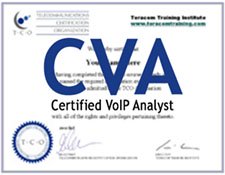
The Certified VoIP Analyst TCO-CVA courses and certification cover the many aspects of Voice over IP. This certificate explains the ways VoIP is implemented; softswitches and SIP and how calls are set up; digitizing and packetizing voice; factors affecting sound quality; carrier connections; SIP trunking; MPLS; Expedited Forwarding and network quality; Service Level Agreements (SLAs) and Class of Service (CoS).
This certification is a specialization in VoIP and SIP. It builds on a base knowledge of telecom fundamentals. If you don't have the base, it is highly recommended that you do CTNS and its eight courses first. There is a package deal with special pricing when you purchase both together.
This specialization certification highlights the fact you have broad and deep vendor-agnostic knowledge of VoIP practices and systems ... which enables higher-paying positions in analysis, report writing and recommendation development as well as accurate and productive contributions in business and product development, project management, software design, marketing, sales and finance roles.
CVA Certification is obtained by passing the CVA Exam, which is 6 individual course exams, each course having 10 multiple-choice questions.
Your CVA Certificate is accompanied by a personalized Letter of Reference providing a detailed list of the knowledge you have.
The CVA Certification Package includes six high-quality multimedia courses:
• 2221 FUNDAMENTALS OF VOIP
• 2222 VoIP ARCHITECTURES & IMPLEMENTATION CHOICES
• 2223 SOFTSWITCHES, SIP, CALL SETUP & SIP TRUNKING
• 2224 VOICE PACKETIZATION, CODECS & VOICE QUALITY
• 2225 CARRIER CONNECTIONS & SIP TRUNKING
• 2226 IP NETWORK QUALITY: COS, SLAs, QOS & MPLS
The Unlimited Plan CVA Certification Package includes the six courses and the Telecommunications Certification Organization TCO-CVA Certification Exam, with unlimited repeats. You can do the courses at your own pace, jump in and out, guaranteed to pass and refresh your knowledge anytime.
CIPTS is a subset of CTA and CTNS. CIPTS concentrates on the fundamentals, concepts and technologies of the new‑generation MPLS+IP+Ethernet+fiber telecom network, leaving out the PSTN and wireless courses.
You will learn the OSI layers, MPLS as a traffic management system for IP Packets; IP Addressing and Routing (Layer 3); Optical Ethernet and MAC frames (Layers 2 and 1) and how they all fit together.
A CIPTS understands the structure and operation of the new-generation telecom network and its MPLS-IP-Ethernet-Fiber/Copper protocol stack, all of the network components and how they fit together. This solid base gives a CIPTS the ability to get up to speed quickly on a particular project, then have the versatility to work on many others. An excellent way to show your potential as a new applicant, or when climbing the ladder at your place of employment.
CIPTS is obtained by passing the four individual course exams, each with 10 multiple-choice questions.
In addition to your certification and certificate, you also get a personalized Letter of Reference that lists all of the areas you are knowledgeable in, and inviting the recipient to contact us for confirmation.
The CIPTS Certification Package includes four high-quality multimedia courses:
• 2212 THE OSI LAYERS & PROTOCOL STACKS
• 2211 LANS, VLANS, WIRELESS & OPTICAL ETHERNET
• 2213 IP NETWORKS, ROUTERS & ADDRESSES
• 2214 MPLS & CARRIER NETWORKS
The CIPTS Certification Package Unlimited Plan includes the courses and CIPTS Exam, with unlimited repeats: guaranteed to pass, refresh your knowledge anytime.
Get all of the knowledge you need for the new-generation MPLS-IP-Ethernet telecom network within these four courses – plus TCO Certification to prove it!
CTSME, the Certified Telecommunications Subject Matter Expert, is the most comprehensive telecommunications, data communications, networking, VoIP, SIP and wireless training and certification available anywhere.
CTSME includes CTA, CVA, CWA and CTNS Courses and Exams bundled at a discounted price. Pass the exam for each certification to get the CTMSE certification.
Pass all the exams and get a signed and sealed CTSME certificate, plus a Letter of Introduction explaining your telecom knowledge and inviting the recipient to contact us as a reference.
You get four TCO Certifications:
CTA Certified Telecommunications Analyst
CVA Certified VoIP Analyst
CWA Certified Wireless Analyst
CTNS Certified Telecommunications Network Specialist
and a total of 25 full-length high-quality courses for preparation and future reference:
CTA Courses
2401 Fundamentals of Telephony & VoIP
2402 Telecom Equipment
2403 Telecommunications Industry
2404 Digital
2405 Fiber Optics Transmission Systems
2406 Wireless Telecommunications
2407 Datacom & Networking Introduction
2408 Data Coding, Frames & Packets
2409 Modems: Representing Bits on Radio & Copper
2410 The Network "Cloud" & Service Implementation
2411 LANs, VLANs, Wireless & Optical Ethernet
2412 The OSI Layers & Protocol Stacks
2413 IP Networks, Routers & Addresses
2414 MPLS & Carrier Networks
2415 The Internet
2416 IP Security
CVA Courses
2221 Fundamentals of VoIP
2222 VoIP Architectures & Implementation Choices
2223 Softswitches, SIP, Call Setup & SIP Trunking
2224 Voice Packetization, Codecs & Voice Quality
2225 SIP Trunking & Carrier Connections
2226 IP Network Quality: CoS, SLAs, QoS & MPLS
CWA Courses
2231 Wireless Fundamentals
2232 Mobile Communications
2233 Fixed Wireless
CTNS Courses
2241 Broadband Converged IP Telecom Introduction
2206 Wireless Telecommunications
2221 Fundamentals of VoIP
2201 The PSTN
2211 LANs, VLANs, Wireless & Optical Ethernet
2212 The OSI Layers & Protocol Stacks
2213 IP Networks, Routers & Addresses
2214 MPLS & Carrier Networks
You get unlimited repeats of courses and exams with the Unlimited Plan, which means guaranteed to pass. You can jump in and out of courses as needed and refresh your knowledge anytime. No time limits!
Twenty-five high-quality courses, four TCO Certifications, plus TCO CTSME Certification and its signed and sealed certificate, at a discounted price!
Get career-enhancing certifications! Upgrade your knowledge and your résumé today!
You are protected with an unconditional
100% money-back, 30-day guarantee.
TCO Telecommunications Certification is confirmation that an individual has obtained broad and deep knowledge of current telecommunications, VoIP, SIP, IP, the network, MPLS and wireless telecommunications technologies.
Taking courses to receive a telecommunications certification is a perfect way to help prepare for a career in the field of telecommunications.
Whether you're a programmer looking for that extra edge or trying to build a broad knowledge in telecommunications, the networks and the many services and technologies, a TCO certification can help.
You can be an employee in sales, marketing, finance, management who is involved with the company telecommunications.
These certifications will bring you up to speed on the telecom knowledge you need to be a success at your job!
The high-quality online courses are delivered through Google Chrome or Puffin browsers to a desktop, laptop, tablet or phone, Windows, Android or mac with an internet connection... to whomever, whenever, and wherever.
Courses are organized into lessons. Take as long as you need on a lesson, then move to the next lesson when you're ready. You can even go back!
Take the course exam only when you're ready. With the Unlimited Plan, you may repeat exams until you pass, and view courses again anytime in the future.
Check out the team training packages with group discount and management reporting
• Instructor-Led Training Courses
• Online Interactive Courses
• Quizzes and Exams
• Group Training Online
• Textbooks
• CTA Study Guide
• eBooks
• Free Tutorials
• Free Training
• Free Course Lessons
• Reference Book
• Telecommunications training
• MPLS training course
• Broadband, telecom, datacom,networking course
• VoIP, SIP, Security, 5G IoT course
• Broadband, telecom, datacom, 5G, networking, VoIP, security, IoT course
• Private Onsite Training
• Wireless training course
• VoIP training course
• IP Call Center contact center course
• IPv6 training course
• Telecom course online
• Telecom 101 reference and textbook for telecommunications
• Blog for telecommunications training
• Training on the fundamentals of telecommunications
• Telecommunications Certification Organization
• Telecommunications in Canada
• IPv6 training
• Training on Telecom
• Training on Networks
• Telecom Certification
• Certification in Telecom
• Telecom Courses
• Online Telecom Course
• Telecom Classes
• Telecommunications Certification
• Training in telecommunications
• Seminars in telecommunications
• Classes in telecommunications
• Courses in telecommunications
• Training in telecommunications
• Tutorials in telecommunications
• Telecommunications Training
• Teracom telecommunications training courses
• Telecom Training Channel
• Telecom Training
• Instructor-led self-study telecommunications training
• VOIP Certification
• Training in VoIP